Position of Yazeed according to Hanafi Usool.

The month of Muharram begins and the Yazeed sympathizers come out of their year long hibernation and start defending him in one way or the other. Though many Salafis defend him unashamedly and declare him to be a righteous Muslim, there are some other who have started to deny his state of kufr and are adjusted to call him a 'Fasiq' and 'Fajir' (An impious and an evil doer). Surprisingly, they exert that their position is based on the position of Imam Abu Hanifa (ر), where he did 'Sukoot' (remained silent) when asked whether Yazeed is a Kaafir. This is a total misinterpretation of the view of Imam Al Ad'ham. Ahlus Sunnah has seen an uprising of a sect within them who have always thrown back the Dhikr of Ahlul Bayth and defend Banu Ummayah whenever and where ever possible. Unusually, one of their website which is run in the guardianship of their ultimate peer has labelled an individual 'Kaafir' if he disrespects a Companion of the Prophet صلى الله عليه وسلم. Blinded by their extreme fondness of Banu Ummayah, they have forgot that Yazeed MURDERED the Grandson of the Prophet صلى الله عليه وسلم, the leader of the believers in Jannah, which, any sane man, would consider a sin much greater than humiliating a companion of the Prophet.
In this article, we will prove that Yazeed is a Kaafir even according to Hanafi usool and the Sukoot of Imam Al Ad'ham (ر) can be taken as his permission to declare him so.
Firstly, we would like to highlight that Yazeed is proved Kafir from Quranic Nass:
Allah says in Surah Ibrahim, Verse 28:
أَلَمْ تَرَ إِلَى الَّذِينَ بَدَّلُوا نِعْمَتَ اللَّهِ كُفْرًا وَأَحَلُّوا قَوْمَهُمْ دَارَ الْبَوَارِ
Firstly, we would like to highlight that Yazeed is proved Kafir from Quranic Nass:
Allah says in Surah Ibrahim, Verse 28:
أَلَمْ تَرَ إِلَى الَّذِينَ بَدَّلُوا نِعْمَتَ اللَّهِ كُفْرًا وَأَحَلُّوا قَوْمَهُمْ دَارَ الْبَوَارِ
Have you not considered those who exchanged the favor of Allah for disbelief and settled their people [in] the home of ruin?
Here, Allah almighty talks about a group of individuals who have rejected Allah's blessing with disbelief and led their families and tribes to destruction. Lets see the Azbab Al Nuzul for this ayah and its commentary
⇼Tafsir Sufiyan Al
Thawri (ر) (d.161H), Pg 157, Narration 464.
قوله تعالى: أَلَمْ تَرَ إِلَى الَّذِينَ بَدَّلُوا نِعْمَتَ اللَّهِ كُفْراً قال مقاتل: كانت النعمة أن الله أطعمهم من جوع، وأمنهم مّنْ خوْفٍ، يعني: من الخوف والقتل. ثم بعث فيهم رسولاً منهم، فكفروا بهذه النعمة وبدّلوها، وهم: بنو أمية، وبنو المغيرة وَأَحَلُّوا قَوْمَهُمْ دارَ الْبَوارِ يعني:
The ones who exchanged the favour of Allah with disbelief are the disbelievers of Makkah (who fought against the Prophet صلى الله عليه وسلم in Badr), i.e Banu Umayyah and Banu Mughairah.
⇼ Tafsir Al Samarqandi (ر) (d.375H), Vol 2, Pg 243.
حَدَّثَنَا أَبُو حُذَيْفَةَ ثَنَا سُفْيَانُ عن أبي إسحق عَنْ عَمْرٍو عَنْ عَلِيِّ بْنِ أبي طالب في قوله تر إلى الذين بدلوا نعمة اللَّهِ كُفْرًا وَأَحَلُّوا قَوْمَهُمْ دَارَ البوار جهنم قَالَ هُمَا الأَفْجَرَانِ مِنْ قُرَيْشٍ بَنُو أُمَيَّةَ وَبَنُو الْمُغِيرَةِ فَأَمَّا
بَنُو الْمُغِيرَةِ فَقَطَعَ اللَّهُ أَدْبَارَهُمْ وَأَمَّا بَنُو أُمَيَّةَ فَمُتِّعُوا إِلَى حين (الآية )28)
Abu Hudaifa narrates from Sufyan
who narrated it from Abi Ishaq narrated it from Umaro from Ali Ibn Abi Talib [رضي الله عنه],
“This verse was revealed for those people who have given up the grace of
Almighty Allah and chose disbelief and introduced their tribes and family to
destruction i.e; the illiterates (hypocrites) of Quraysh who fough the Prophet صلى الله عليه وسلم on the day of Badr, Banu Umayyah and Banu
Mughairah. The Banu Mughairah were cut down (killed) on the day of Badr where as the Banu Umayyah enjoyed (kufr) for a little while (after Badr).
وهم أهل مكة: أسكنهم الله حرمه، وجعلهم قوّام بيته، وأكرمهم بمحمد صلى الله عليه وسلم، فكفروا نعمة الله بدل ما لزمهم من الشكر العظيم. أو أصابهم الله بالنعمة في الرخاء والسعة لإيلافهم الرحلتين، فكفروا نعمته، فضربهم بالقحط سبع سنين، فحصل لهم الكفر بدل النعمة، كذلك حين أسروا وقتلوا يوم بدر وقد ذهبت عنهم النعمة وبقي الكفر طوقا في أعناقهم. وعن عمر رضى الله عنه: هم الأفجران من قريش: بنو المغيرة وبنو أمية، فأما بنو المغيرة فكفيتموهم يوم بدر. وأما بنو أمية فمتعوا حتى حين.
It was revealed for the people of
Makkah. They were blessed with the Prophet صلى الله عليه وسلم and the message of Islam but instead
they rejected those blessings and turned away the grace of Allah. As a result,
Allah’s wrath descended upon them and they were hit by a drought for seven
years. On the day of Badr, the disbelief remained in their necks (i.e; they
didn’t truly embraced Islam). It is narrated from Umar رضي الله عنه that this refers to the
people of Banu Mughairah, Banu Umayyah and the fools of Quraysh. The Banu Mughairah were cut down (killed) on the day of Badr where as the Banu Umayyah enjoyed (kufr) for a little while (after Badr).
⇼ Tafsir Zamakshari (ر) (d.522H), Single Vol Ed,
Dar Al Marifah, Beirut, Lebanon, Pg 551-552.
 |
| Tafsir Sufiyan Al Thawri, Pg 157. |
 |
| Tafsir Zamakshari, Pg 551-552 |
حدثنا ابن بشار وأحمد بن إسحاق ، قالا : ثنا أبو أحمد ، قال : ثنا سفيان ، عن علي بن زيد ، عن يوسف بن سعد ، عن عمر بن الخطاب ، في قوله : (ألم تر إلى الذين بدلوا نعمة الله كفرا وأحلوا قومهم دار البوار جهنم ) قال : هما الأفجران من قريش : بنو المغيرة ، وبنو أمية ، فأما بنو المغيرةفكفيتموهم يوم بدر
The people who gave up Allah's blessings for disbelief are the hypocrites of Makkah i.e; Banu Umayyah and Banu Mughairah.
حدثنا أحمد بن إسحاق ، قال : ثنا أبو أحمد ، قال : ثنا سفيان وشريك ، عن أبي إسحاق ، عن عمرو ذي مر ، عن علي ، قوله( ألم تر إلى الذين بدلوا نعمة الله كفرا وأحلوا قومهم دار البوار ) قال : بنو المغيرة وبنو أمية ، فأما بنو المغيرة ، فقطع الله دابرهم يوم بدر ، وأما بنو أمية فمتعوا إلى حين .
The people who chose disbelief over Allah's grace are the hypocrites of Makkah, Banu Umayyah and Banu Mughairah. As for Banu Mughairah, they were cut off (killed) on the day of Badr while Banu Umayyah enjoyed (kufr) for a little time (after Badr).
⇼ Tafsir Al Tabari (ر) (d.310H), Vol 5, Pg 06.
أَلَمْ تَرَ إِلَى الَّذِينَ بَدَّلُوا نِعْمَتَ اللَّهِ كُفْراً» وهم بنو أمية، وبنو المغيرة المخزومي
The people who chose disbelief over Allah's blessings were the people of Banu Mughairah and Banu Umayyah who fought the Prophet صلى الله عليه وسلم.
⇼ Tafsir Muqatil bin Sulayman (d.150H), Vol 2, Pg 406.
It was revealed for the tribes of Banu Umayyah and Banu Mughairah as related from Umar and Ali ibn Abi Talib [رضي الله عنه]. Abu Salih has also narrated the same from Ibn Abbas.
⇼ Tafsir Za'ad Al Mase'er, Ibn Jawzi (ر) (d.537H), Vol 2, Pg 513.
 |
| Tafsir Muqatil Al Razi, Vol 2, Pg 406. |
 |
| Tafsir Za'ad Al Maseer, Vol 2, Pg 513. |
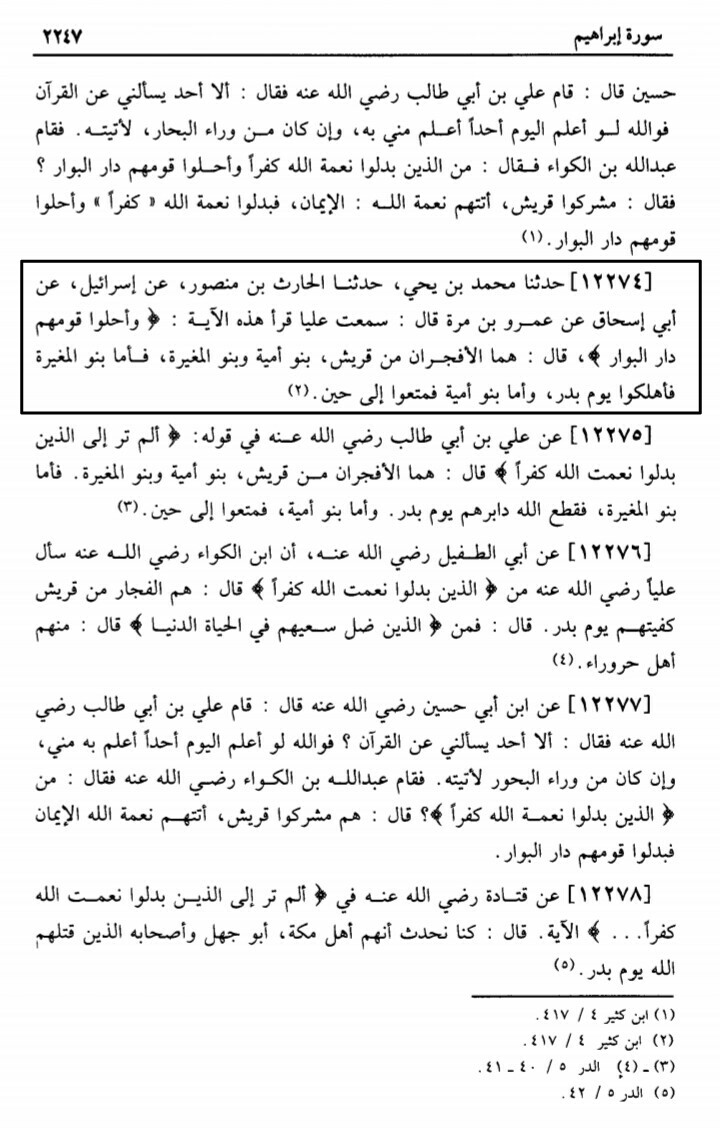
حدثنا محمد بن يحي، حَدَّثَنَا الحَارِث بن مَنْصُور، عَنِ إِسْرَائِيلُ، عَنِ أَبِي إِسْحَاقَ عَنْ عَمْرِو بْنِ مرة قَالَ: سمعت عليا قرأ هذه الآية: وَأَحَلُّوا قَوْمَهُمْ دَارَ الْبَوَارِ، قَالَ: هما الأفجران مِنْ قريش، بنو أمية وبنو المغيرة، فأما بنو المغيرة فأهلكوا يَوْم بدر، وأما بنو أمية فمتعوا إِلَى حين
This was revealed for the hypocrites of Makkah i.e, Banu Mughairah and Banu Umayyah. The Banu Mughairah were killed on the day of Badr where as the Banu Umayyah enjoyed (kufr) for a little time.
⇼ Tafsir Al Quran Al Azeem, Ibn Abi Hatim Al Razi (ر) (d.267H), Single Vol Ed, Maktabah Al Shamiyya, Makkah, Pg 2247, Narration no 12274.
 |
| Tafsir Abi Hatim, Pg 2247. |
قوله تعالى: أَلَمْ تَرَ إِلَى الَّذِينَ بَدَّلُوا نِعْمَتَ اللَّهِ كُفْراً قال مقاتل: كانت النعمة أن الله أطعمهم من جوع، وأمنهم مّنْ خوْفٍ، يعني: من الخوف والقتل. ثم بعث فيهم رسولاً منهم، فكفروا بهذه النعمة وبدّلوها، وهم: بنو أمية، وبنو المغيرة وَأَحَلُّوا قَوْمَهُمْ دارَ الْبَوارِ يعني:
The ones who exchanged the favour of Allah with disbelief are the disbelievers of Makkah (who fought against the Prophet صلى الله عليه وسلم in Badr), i.e Banu Umayyah and Banu Mughairah.
⇼ Tafsir Al Samarqandi (ر) (d.375H), Vol 2, Pg 243.
وَقِيلَ: نَزَلَتْ فِي الْمُشْرِكِينَ الَّذِينَ قَاتَلُوا النَّبِيِّ صَلَّى اللَّهُ عَلَيْهِ وَسَلَّمَ يَوْمَ بَدْرٍ. قَالَ أَبُو الطُّفَيْلِ: سَمِعْتُ عَلِيًّا رَضِيَ اللَّهُ عَنْهُ يَقُولُ: هُمْ قُرَيْشٌ الَّذِينَ نُحِرُوا يَوْمَ بَدْرٍ. وَقِيلَ: نزلت في الأفجرين من قريش بني محزوم وَبَنِي أُمَيَّةَ، فَأَمَّا بَنُو أُمَيَّةَ فَمُتِّعُوا إِلَى حِينٍ،
This was revealed for the hypocrites of Makkah i.e; Banu Mughairah and Banu Umayyah who chose disbelief over Allah's blessing. The Banu Mughairah were killed on the day of Badr where as Banu Umayyah rejoiced (kufr) for a while as related by Umar رضي الله عنه and Ali Ibn Abi Talib عليه سلام .
⇼ Tafsir Al Qurtubi (ر) (d.651H), Vol 12, Pg 140-141.
حدثنا أبو العباس محمد بن يعقوب ، ثنا محمد بن علي بن ميمون الرقي ، ثنا محمد بن يوسف الفريابي ، ثنا سفيان ، عن أبي إسحاق ، عنعمرو ذي مر عن علي رضي الله عنه ، في قوله عز وجل : وأحلوا قومهم دار البوار قال : هم الأفجران من قريش ، بنو أمية وبنو المغيرة ، فأما بنو المغيرة فقد قطع الله دابرهم يوم بدر ، وأما بنو أمية فمتعوا إلى حين .
هذا حديث صحيح الإسناد ولم يخرجاه .
هذا حديث صحيح الإسناد ولم يخرجاه .
The verse, "Have you not considered those who exchanged the favor of Allah for disbelief and settled their people [in] the home of ruin?" was revealed for the disbelievers of Quraysh, the Banu Mughairah and Banu Umayyah. The Banu Mughairah were killed on the day of Badr where as the Banu Umayyah enjoyed (kufr) for a little time.
⇼ Mustadrak Ala Sahihayn, Imam Hakim (ر), Vol 2, Pg
383, Hadith 3343, Graded Sahih by Imam Hakim.
 |
| Tafsir Al Qurtubi, Vol 12, Pg 140-141. |
 |
| Mustadrak Al Hakim, Vol 2, Pg 383. |
The same is also narrated by Ibn Kathir in his Tafsir, Tab rani in Al Awsat, Al Nasafi in his Tafsir, Al Baghawi in his Tafsir, Al Razi in his Tafsir.
We read in Tafsir Al Mazhari of Qadi Thanaullah Panipathi (ر) (d.1225 H), Vol 5, Pg 135, under the exegesis of Surah Ibrahim (14), Ayah 28,
Bani Umaiyya had always rejoiced upon Kufr....Yazid and his companions rejected the blessings of Allah and rose the flag of enmity towards Ahlul Bayt عليه سلام and finally brutally martyred Imam Hussain عليه سلام and comitted kufr to the extent that Yazeed even denied the religion of Muhammad صلى الله عليه وسلم. He (Yazeed) considered Alcohol to be permissible and in praise of it he said: If liquor is Haram in the Deen of Muhammad then take it to be permissible according to the deen of Isa Ibn Maryam عليه سلام.
 |
| Tafsir Al Mazhari, Vol 5, Pg 135. |
Qadi Thanaullah Panipathi further writes that, "Except for Abu Sufyan, Muawiya, Umaro bin Al Aas every person of Banu Ummayah has rejoiced kufr." This undoubtedly proves that Yazeed rejected the Quran and considered the impermissible as permissible. Hence, basing on the Qaul of Imam Abu Hanifa (ر), he will be considered as Kaafir.
It has been explicitly proved now that the disbelief runs in the blood of Banu Umayyah and Allah has said that they disbelieved in Him meaning they were still in the state of Kufr. Any further argument of anyone doesn't stand as an argument against the Quran. It is to be noted that the scholars of the Salaf have not excluded people like Abu Sufyan, Muawiya and Amr bin Al Aas from the circle of Banu Umayyah who had disbelieved as Qadi Thanaullah did. As mentioned, Banu Mugairah were killed on the day of Badr where as Banu Umayyah rejoiced (with kufr) for a little while.
Now, it is popularly known that Imam Abu Hanifa (ر) would never consider a person kaafir unless the individual deems his sins to be permissible. He said in his famous works,
"No muslim should be declared devoid of faith (declared kaafir) on account of any sin. If he does not declare it to be lawful. One may be a man of faith with bad behavior, but not an infidel." [Narrated in Fiqh Al Akbar and Fiqh Al Absaat].
It is a well known fact that the authenticity of both the books is disputed. Both the books were not scribed by Imam Abu Hanifa (ر) himself. Fiqh Al Akbar was written by Hammad bin Abi Hanifa (ر) who was popular among the traditionists to have a weak memory where as Fiqh Al Absat was written by Abu Mut'ii Al Balqhi who was a Mutazi'la in doctrine. Both cannot be trusted completely. I consider Hammad to be trustworthy but Al Balqhi is proven liar who attributed lies to Imam Abu Hanifa (ر). I will not totally weaken their position by using the traditionalists opinion of them. It is crucial to understand that this statement of Abu Hanifa (ر) is almost in harmony with the main doctrine of Murji'as. For those who dont know who Murji'a are, they were a heretical sect who believed that
1) Unwilling to pass judgement on an individual's faith, the Murji’a were generally loyal to their rulers. But Abu Hanifa (ر) supported the rebellion of Zaid bin Ali عليه سلام against Hisham by granting him an aid of 10,000 dirhams. [See Al Makki, Manaqib, Vol 1, Pg 260; Al Kardari (d.807H), Manaqib, Vol 1, Pg 255]. This stands in clear contrast to the main doctrine of Murji'a.
2) While supporting the rebellion of Imam Zaid bin Ali عليه سلام, Abu Hanifa (ر) passed a legal opinion that, "Fighting on the side of Zaid bin Ali is like fighting besides the prophet صلى الله عليه وسلم on the day of Badr." With this Fatwa, he has equaled the forces of Hisham bin Abdal Malik with the disbelievers of Makkah which is again in contrast to the ultimate doctrine of Murji'a.[See Abu Zuhra's Hayat Wa Asr, Pg 36-37].
If Abu Hanifa (ر) was not convinced with the crimes (acts of disobedience) of Hisham, he would never has equaled him with the likes of Abu Lahab and Abu Jahl. Hence, it is proved that Abu Hanifa (ر) did consider that acts of extreme disobedience would nullify ones faith. Yazeed was much worse than Hisham. Even if it is assumed that Abu Hanifa (ر) didn't pass his opinion on faith in anyone's influence, even then it could not be applied to Yazeed as his disbelief is proved from the Quran as cited above. This Usool can also be rejected as there are a number of traditions which asserts a number of acts which when carried out nullifies the faith of an individual. Some of them are:
"Acts (amal) doesn't form a part of faith and faith is only acceptance by heart and confession by the tongue sincerely. So, even if a person sins relentlessly, he would not be considered a disbeliever and he could attain salvation through is sincerity and love of God." [See Al Sharasthani, Kitab Al Milal Wal Nihal, English Ed, Chapter 5, Pg 119].In the conclusion of the chapter on Murji'a, Al Sharasthani names Hammad bin Abi Sulayman, Sae'ed bin Jubayr, Abu Hanifa, Muhammad bin Hasan, Abu Yusuf [(ر)] among the most prominent Murji'an authorities of their times as they didn't believe that acts form a part of faith (unlike the traditionists). It is also alleged that At'a bin Abi Rabah (ر), one of the senior Tab'ii, companion of Ibn Abbas and the teacher of Abu Hanifa (ر) aided and gave refuge to the Murji'a fugitives who fled towards Makkah. Though it is impossible to prove that these scholars were Murji'a in doctrine but, at this point, we know that many great teachers of Imam Abu Hanifa (ر) were influenced (or accompanied) by Murji'a. Though Abu Hanifa indulged deeply in theological studies in his time, he then realized that it had many adverse effects and shifted his interests from Theology to Fiqh.
In one place Hammad bin Abi Hanifa (ر) is said to have told how his father directed him to study kalam and later changed his mind, and told him to revert to fiqh, for kalam seemed futile to him. [See Manaqib Al Imam Al Azam, Muhammad Al Makki (d.568H), Vol 1, Pg 207-208, 1321H, Hyderabad Ed]. Also, Abu Hanifa's spiritual will to Abu Yusuf, where he advised him to avoid entanglement in theology [Ibid, Vol 2, Pg 112].Imam Abu Hanifa (ر) studies fiqh under Imam Hammad bin Abi Sulayman (ر). He studied in his circle for about 20 years till the later passed away. It is possible that Abu Hanifa would have acquired this concept of Iman from his teacher who was one of the prominent figures of Murji'a, in his earlier days. If this was the case, then it is proved that Abu Hanifa (ر) gave up the doctrine of Murji'a in his latter days. This could be understood by the following events:
1) Unwilling to pass judgement on an individual's faith, the Murji’a were generally loyal to their rulers. But Abu Hanifa (ر) supported the rebellion of Zaid bin Ali عليه سلام against Hisham by granting him an aid of 10,000 dirhams. [See Al Makki, Manaqib, Vol 1, Pg 260; Al Kardari (d.807H), Manaqib, Vol 1, Pg 255]. This stands in clear contrast to the main doctrine of Murji'a.
2) While supporting the rebellion of Imam Zaid bin Ali عليه سلام, Abu Hanifa (ر) passed a legal opinion that, "Fighting on the side of Zaid bin Ali is like fighting besides the prophet صلى الله عليه وسلم on the day of Badr." With this Fatwa, he has equaled the forces of Hisham bin Abdal Malik with the disbelievers of Makkah which is again in contrast to the ultimate doctrine of Murji'a.[See Abu Zuhra's Hayat Wa Asr, Pg 36-37].
 |
| Manaqib Imam Al Azam, Al Makki, Vol 1, Pg 260. |
 |
| Hayat wa Asr, Abu Zuhra, Pg 36-37. |
If Abu Hanifa (ر) was not convinced with the crimes (acts of disobedience) of Hisham, he would never has equaled him with the likes of Abu Lahab and Abu Jahl. Hence, it is proved that Abu Hanifa (ر) did consider that acts of extreme disobedience would nullify ones faith. Yazeed was much worse than Hisham. Even if it is assumed that Abu Hanifa (ر) didn't pass his opinion on faith in anyone's influence, even then it could not be applied to Yazeed as his disbelief is proved from the Quran as cited above. This Usool can also be rejected as there are a number of traditions which asserts a number of acts which when carried out nullifies the faith of an individual. Some of them are:
Beware don't renegade (as) disbelievers (turn into infidels) after me, by striking the necks (cutting the throats) of one another (i.e., by killing one another)." (Narrated by Ibn Abbas رضي الله عنه, Vol 2, Pg 450, Hadith 1739 & 1741 and Vol 9, Pg 133, Hadith 7079)
If a man says to his brother, 'O Kafir (disbeliever)!' Then surely, one of them is such (i.e., a Kafir) i.e If the accuser is telling the truth, then the accused person is a disbeliever, otherwise the accuser is a disbeliever, because in this case, he regards belief as disbelief. (Narrated by Abu Huraira, Ibn Umar, Thabit bin Ad Dhahak [رضي الله عنه], Vol 8, Pg 78, Hadith 6103, 6104 & 6105).
“Do not become disbelievers after me by cutting the necks of one another." (Narrated by Ibn Umar رضي الله عنه, Vol 8, Pg 109, Hadith 6166, Vol 9, Pg 15, Hadith 6868). One may argue that this is minor type of disbelief and Allah will forgive it. Surprisingly, these statements cannot be backed up with evidences. But the contrary is corroborated by the hadith in which the Prophet predicted the martyrdom of Ammar bin Yasir رضي الله عنه and said that the party which shall murder Ammar will invite him to Hell fire (with them).
After me (i.e., after my death), do not become disbelievers by striking (cutting) the necks of one another. (Narrated by Abu Zura bin Amr bin Jarir رضي الله عنه, Vol 9, Pg 15, Hadith 6869).
"Whosoever takes up arms against us, is not from us."(Narrated by Ibn Umar, Abu Musa, Abu Huraira [رضي الله عنه], Vol 9, Pg 130, Hadith 7070, 7071 & 7072).
“Abusing a Muslim is Fusuq (evil-doing) and killing him is Kufr (disbelief)”. (Narrated by Abdullah رضي الله عنه, Vol 9, Pg 132, Hadith 7076).Furthermore, the Prophet صلى الله عليه وسلم has said, "I am at war with those who fight Ali, Hasan, Hussain and Fatima [عليه سلام] and in peace with those who are peaceful to them." [Narrated by Zaid bin Arqam in Jami Al Tirmidhi, Vol 6, Pg 487, Hadith 3870, English Ed, Darussalam Publications. It has been graded Gharib by Imam Tirmidhi. Also narrated by Abu Huraira in Fadail Al Sahaba, Ahmed bin Hanbal, Single Vol Ed, Pg 767, Hadith 1350, Sunan Ibn Majah, Vol 1, Pg 172, Hadith no 145, Darussalam Publication]. It has been explicitly described in the hadith what happens to the state of the believer when he/she fights the Prophet صلى الله عليه وسلم.
Abu Qilaba added, "Those people (of Ukl and Uraina tribe) committed theft, murder,and thus became disbelievers after embracing Islam (Murtadin) as they fought against Allah and His Messenger صلى الله عليه وسلم. (Vol 1, Pg. 179, Hadith 233).
Additionally, even if all these points seem weak (as is expected from a true lover of Yazeed) and if he is still not satisfied, we can nonetheless prove Yazeed to be a Kaafir from the same usool of Abu Hanifa, which they use to defend him. The complete quote of Imam Abu Hanifa is:
We do not declare any Muslim a blasphemer because of a sin, however grave, unless that Muslim considers the sin permissible. Nor do we revoke the status of belief from him; and we continue to call him a believer, genuinely. It is possible to be a sinful believer [deviant] without being a blasphemer.So, if a believer considers his sins to be permissible, he/she is to be considered as a Kaafir (disbeliever). We have already quoted the poem which Yazeed used to chant [See Tafsir Mazhari]. He considered alcohol to be permissible. Moreover, when Imam Hussain left for karbala, he delivered this sermon to his followers and followers of Hurr
According to Abu Mikhnaf- Uqbah bin Abi Al Ayzar: Al-Husayn عليه سلام preached to his followers and the followers of al-Hurr at al-Bidah. After praising and glorifying God, He said: "People, the Apostle of God said : 'When anyone sees the authorities make permissible what God had forbidden, violating God's covenant, and opposing the Sunnah of the Apostle of God by acting against the servants of God sinfully and with hostility , when anyone sees all these incidents and does not upbraid them by deed or by word, it is God's decree to make that person subject to fortune.' Indeed, these authorities have cleaved to obedience to Satan and have abandoned obedience to the Merciful, they have made corruption visible; they have neglected the punishment (hudud) laid down by God; they have appropriated the fay' exclusively to themselves; they have permitted what God has forbidden, and they have forbidden what He has permitted. [Tarikh Al Tabari, Vol 19, Pg 95-96, The Caliphate of Yazeed bin Muawiya, English Ed].
 |
| Tarikh Tabari, Vol 19, Pg 95-96. |
Note: The chain of transmission of this incident is strong. Uqbah bin Abi Ayzar was a traditionist who died during the first half of the First century Hijra.
Conclusion: It has been proved from the Quran, Hadith, Qiyas and even through the Qaul of Imam Abu Hanifa (ر) that Yazeed is a Kaafir. If Imam Abu Hanifa (ر) didn't consider the sins of Yazeed to be grave (for his faith to be nullified), he wouldn't have remained silence when asked about the Iman of Yazeed.
The Pseudo Sunnis very well know that implication of "Sukoot" in Fiqh is always taken as "Yes" or "permissible". But in this case, they have considered it as a "No" or "Impermissible". This is total distortion of the Usool for personal interests.
To All the companions and scholars mentioned in this article, May Allah be pleased with them.
Note: Don't even try to accuse me of disrespecting Imam Abu Hanifa. If anyone is offended, then I suggest them to go back and continue worshiping Yazeed. I am a Hanafi Maturidi and probably have more knowledge about the school of Abu Hanifa than your Peer/Shaykh.
Note: Don't even try to accuse me of disrespecting Imam Abu Hanifa. If anyone is offended, then I suggest them to go back and continue worshiping Yazeed. I am a Hanafi Maturidi and probably have more knowledge about the school of Abu Hanifa than your Peer/Shaykh.

